 That Vibe Coder
This newsletter used to be a one man job. Then I made some new hires.
The only part I still do myself is the writing, and I talk that into Wispr Flow instead of typing it. Everything else is run by a team of AI agents I built in Notion.
Why I Built It
A team catches the things you would never see on your own. That is the whole reason it earns its seat.
Here is what it caught for me. I started promoting my community in the newsletter, and a few weeks in my open rates slid for no reason I could see. Nothing about the writing had changed. Gmail had quietly been filing me into the Promotions tab the entire time.
- It found the cause - the promotional language in the copy, not the send times
- It fixed the copy - rewrote what was triggering the filter
- It kept learning - every issue now gets checked against what keeps us in the main inbox
The Newsletter Team
Inside my Notion there is a marketing department, and inside that department there is a newsletter team. This is the actual page:
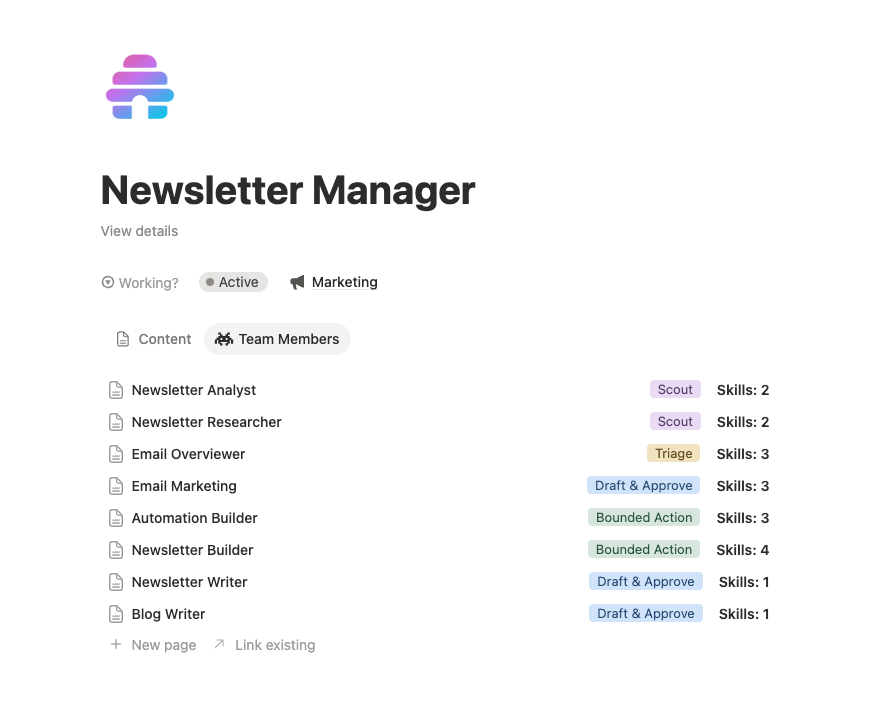
Each agent owns a single job and nothing else:
| Seat | What it owns |
|---|---|
| Pre send review | Checks every issue, the A/B tested titles, meta descriptions, and analytics |
| Segments | Keeps the list clean so issues only go to people who actually read them |
| Win back | Built and runs the series that emails quiet subscribers |
| Welcome flow | Handles the emails every new subscriber gets |
What Happened When I Staffed It
Staffing this team up more than doubled my open rate. Earlier this summer one of my free templates took off and grew the list fast, which dragged the open rate down with it.
- Before the growth spike - around 47 percent open rate
- After the list ballooned - down to 27 percent
- After the team fixed it - the last three issues all opened above 60 percent
The newer agents build full funnels on their own, welcome flows and win back campaigns with the guides and frameworks already baked in. My job is engineering the goal and hitting publish.
Try This on Your Business
You do not need the whole department to start. This one began with a single agent doing a single job.
- Pick one job you keep doing by hand - follow ups, scheduling posts, whatever you dread
- Write the playbook for it - how you do it, what done looks like, what it needs to see
- Give that one job to an agent - then add teammates as the first one proves out
If you want the management side of this, I wrote about running an agent team and about building your first one in 30 days.
Before You Go
If you would rather build a team like this with help instead of alone, that is the whole point of The Vibe Stack. You set up the command center in week one and start adding agents from there, and I am in there answering questions as you go.
Founding members are getting in at the floor while I build it out.